

Commercial Lease Disputes in New Jersey: What Tenants and Landlords Need to Know

By Peter J. Lamont, Esq.

Whether you are a small business owner leasing retail space in Bergen County or a landlord managing a commercial property in northern New Jersey, commercial lease disputes in New Jersey are more common than most people realize. A disagreement over rent increases, unexpected charges for common area maintenance, or a tenant's alleged violation of the lease terms can escalate quickly, threatening both the business and the property investment. Understanding the most frequent sources of conflict, your rights under New Jersey law, and the remedies available to you is the first step toward resolving these disputes efficiently and protecting your interests.
Common Issues That Lead to Commercial Lease Disputes in New Jersey
Commercial lease disputes in New Jersey tend to fall into a few recurring categories. Recognizing these patterns early can help both tenants and landlords avoid costly litigation.
Rent disputes are among the most frequent triggers. These often arise when a landlord seeks to increase rent beyond what the tenant expected, when a tenant withholds rent due to unresolved maintenance issues, or when the parties disagree about how rent escalation clauses should be calculated. In New Jersey, the terms of the lease itself generally control, and courts will enforce clear, unambiguous rent provisions as written. The problem is that many commercial leases contain language that is anything but clear, which is why disputes over the meaning of a single paragraph can end up before a judge.
Use and occupancy restrictions also generate conflict. A tenant who opens a business that the landlord believes falls outside the permitted use clause, or a landlord who leases adjacent space to a direct competitor in violation of an exclusivity provision, can find themselves in a dispute that affects both the lease and the viability of the business.
Maintenance and repair obligations are another common source of tension. Unlike residential leases, where New Jersey law imposes significant obligations on landlords, commercial real estate transactions are governed largely by the terms of the lease agreement. If the lease assigns responsibility for HVAC, plumbing, or structural repairs to the tenant, the tenant generally cannot demand that the landlord cover those costs, even if the expense is substantial. Disputes arise when the lease language is vague or when one party believes the other has neglected its obligations.
CAM Charges: A Frequent Source of Commercial Lease Disputes
Common area maintenance (CAM) charges deserve special attention because they are one of the most litigated issues in commercial leasing. CAM charges are the fees that a landlord passes through to tenants to cover the costs of maintaining shared areas of a property, including parking lots, lobbies, landscaping, and building systems.
The disputes typically involve one or more of the following issues: the landlord includes expenses in CAM that the tenant believes should not be passed through, such as capital improvements or the landlord's administrative overhead; the charges increase dramatically from year to year without adequate explanation; or the landlord fails to provide the detailed accounting that the lease requires.
New Jersey courts have consistently held that a landlord's right to recover CAM charges depends on the specific language of the lease. If the lease defines recoverable expenses broadly, the landlord has wide latitude. If the lease limits CAM to specific categories, the landlord cannot unilaterally expand those categories. Tenants who suspect they are being overcharged should review their lease carefully and, if the lease provides for it, exercise their right to audit the landlord's CAM records. In our Bergen County practice, we regularly advise both tenants and landlords on how to structure CAM provisions that reduce the risk of future disputes.
Lease Violations and Cure Periods Under New Jersey Law
When one party to a commercial lease believes the other has violated the agreement, the next steps depend on the nature of the violation and the terms of the lease itself. Most well-drafted commercial leases include a notice-and-cure provision that requires the non-breaching party to provide written notice of the alleged violation and give the other side a specified period, often 10 to 30 days, to correct the problem before further action can be taken.
For landlords, common tenant violations include failure to pay rent, unauthorized alterations to the premises, subletting without permission, and operating outside the scope of the permitted use clause. For tenants, common landlord violations include failure to maintain the building structure, interference with the tenant's quiet enjoyment of the premises, and failure to provide essential services such as heat, water, or electricity.
Under New Jersey law, a party who has been materially harmed by a breach of contract may seek damages, specific performance, or, in some cases, termination of the lease. However, the availability of these remedies depends heavily on the lease terms and whether the breach is considered material or minor. New Jersey courts apply a fact-sensitive analysis, weighing the severity of the breach, whether it can be cured, and the relative harm to each party.
Early Termination: Rights and Risks for Both Parties
Early termination of a commercial lease is one of the most consequential decisions either party can make, and it is often at the center of the most contentious commercial lease disputes in New Jersey.
From the tenant's perspective, a desire to terminate early may stem from financial hardship, a change in business strategy, or a belief that the landlord has breached the lease. Some commercial leases include an early termination clause that allows the tenant to exit the lease upon payment of a specified fee or after providing a certain amount of notice. Where no such clause exists, a tenant who walks away from the lease before it expires faces potential liability for the remaining rent due under the lease term.
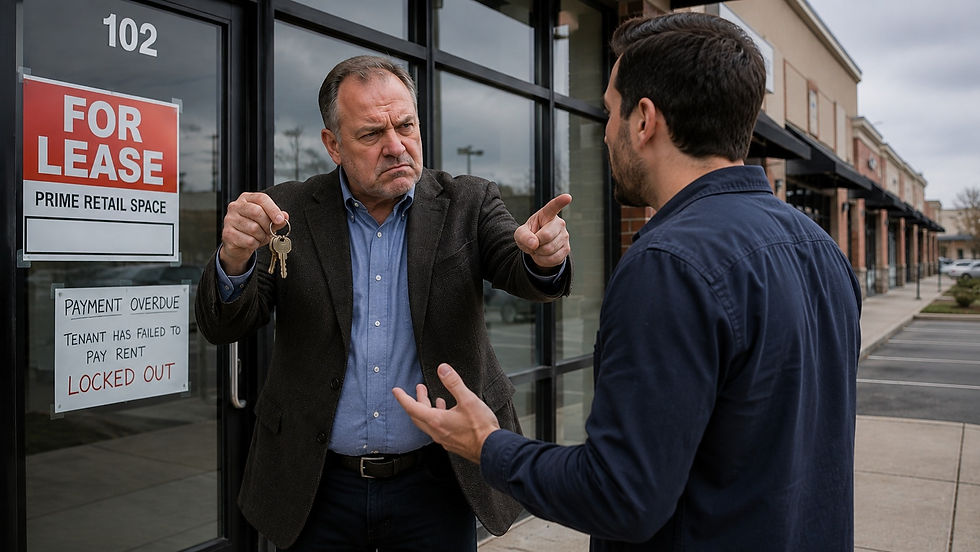
From the landlord's perspective, early termination usually takes the form of an eviction proceeding based on the tenant's default. New Jersey's commercial eviction process is governed by statute, and landlords must follow specific procedural steps, including proper notice and, in many cases, a court action, before regaining possession of the property. Self-help evictions, where a landlord changes the locks or removes a tenant's property without a court order, are prohibited and can expose the landlord to significant liability.
New Jersey also recognizes the duty to mitigate damages in commercial lease disputes. If a tenant vacates early, the landlord generally cannot simply sit back and collect rent for the remainder of the lease term without making reasonable efforts to re-let the space. This mitigation obligation can significantly reduce the damages a landlord is entitled to recover.
Tenant vs. Landlord: Understanding Your Rights in a Commercial Lease Dispute
One of the most important things to understand about commercial lease disputes in New Jersey is that the balance of rights between tenant and landlord is very different from residential leasing. New Jersey's residential tenant protections, including the Anti-Eviction Act, do not apply to commercial tenancies. Commercial tenants and landlords are generally treated as sophisticated parties who negotiated their lease at arm's length, and courts will enforce the lease as written.
That said, both parties have important rights. Commercial tenants have the right to quiet enjoyment of the premises, meaning the landlord cannot unreasonably interfere with the tenant's use of the space. Tenants also have the right to receive any disclosures or accountings required by the lease, and the right to cure defaults within the time frames specified in the agreement.
Landlords have the right to receive rent and additional charges as specified in the lease, to enforce use restrictions and other covenants, and to pursue real estate litigation when a tenant defaults. Landlords also retain the right to enter the premises for inspections and repairs, subject to any notice requirements in the lease.
Both parties should understand that New Jersey courts will look at the totality of the circumstances when resolving these disputes. A party that has acted in good faith, provided proper notice, and attempted to resolve the issue before resorting to litigation will generally be in a stronger position than one that has not.
When to Hire a New Jersey Commercial Lease Disputes Attorney
Not every disagreement over a commercial lease requires a lawyer, but many do. The stakes in commercial leasing are significant: a tenant may be locked into a multi-year obligation worth hundreds of thousands of dollars, and a landlord's property value can be directly affected by how lease disputes are handled.
You should consider consulting with a New Jersey business attorney experienced in commercial lease disputes if you are facing a demand for unpaid rent or CAM charges that you believe are unjustified; if your landlord or tenant has alleged a lease violation and you are unsure how to respond; if you are considering terminating a lease early and want to understand your exposure; if you need to pursue or defend against an eviction proceeding; or if you are in the process of negotiating a new lease and want to ensure that the terms adequately protect your interests.
At the Law Offices of Peter J. Lamont, we have extensive experience representing both commercial tenants and landlords throughout New Jersey. Whether you are dealing with a rent dispute in Wyckoff, a CAM charge conflict in Bergen County, or a lease termination issue anywhere in the state, early legal guidance can make the difference between a manageable resolution and a protracted, expensive legal battle.
Contact us today to discuss your business or legal matter. Put our 20+ years of legal experience to work for you.
For detailed insights and legal assistance on topics discussed in this post, including litigation, contact the Law Offices of Peter J. Lamont at our Bergen County Office. We're here to answer your questions and provide legal advice. Contact us at (201) 904-2211 or email us at info@pjlesq.com.
Interested in More Legal Insights?
Explore our range of resources on business and legal matters. Subscribe to our podcast and YouTube channel for a wealth of information covering various business and legal topics. For specific inquiries or to discuss your legal matter with an attorney from our team, please email me directly at pl@pjlesq.com or call at (201) 904-2211. Your questions are important to us, and we look forward to providing the answers you need.

About Peter J. Lamont, Esq.
Peter J. Lamont is a nationally recognized attorney with significant experience in business, contract, litigation, and real estate law. With over two decades of legal practice, he has represented a wide array of businesses, including large international corporations. Peter is known for his practical legal and business advice, prioritizing efficient and cost-effective solutions for his clients.
Peter has an Avvo 10.0 Rating and has been acknowledged as one of America's Most Honored Lawyers since 2011. 201 Magazine and Lawyers of Distinction have also recognized him for being one of the top business and litigation attorneys in New Jersey. His commitment to his clients and the legal community is further evidenced by his active role as a speaker, lecturer, and published author in various legal and business publications.
As the founder of the Law Offices of Peter J. Lamont, Peter brings his Wall Street experience and client-focused approach to New Jersey, offering personalized legal services that align with each client's unique needs and goals.
DISCLAIMERS: The contents of this website and post are intended to convey general information only and not to provide legal advice or opinions. The contents of this website and the posting and viewing of the information on this website should not be construed as, and should not be relied upon for, legal or tax advice in any particular circumstance or fact situation. Nothing on this website is an offer to represent you, and nothing on this website is intended to create an attorney‑client relationship. An attorney-client relationship may only be established through direct attorney‑to‑client communication that is confirmed by the execution of an engagement agreement.
As with any legal issue, it is important that you obtain competent legal counsel before making any decisions about how to respond to a subpoena or whether to challenge one, even if you believe that compliance is not required. Because each situation is different, it may be impossible for this article to address all issues raised by every situation encountered in responding to a subpoena. The information below can give you guidance regarding some common issues related to subpoenas, but you should consult with an attorney before taking any actions (or refraining from acts) based on these suggestions. This post will also focus on New Jersey law. If you receive a subpoena in a state other than New Jersey, you should immediately seek the advice of an attorney in your state, as certain rules differ in other states.
Disclaimer: Recognition by Legal Awards
The legal awards and recognitions mentioned above do not constitute an endorsement or guarantee of future performance. These honors reflect an attorney's past achievements and should not be considered as predictors of future results. They are not intended to compare one lawyer's services with those of other lawyers. The process for selecting an attorney for these awards can vary and may not include a review of the lawyer's competence in specific areas of practice. Potential clients should perform their own evaluation when seeking legal representation. No aspect of this advertisement has been approved by the Supreme Court of New Jersey.


Comments