

Can a Business Represent Itself in Court in New Jersey? Why You Need an Attorney

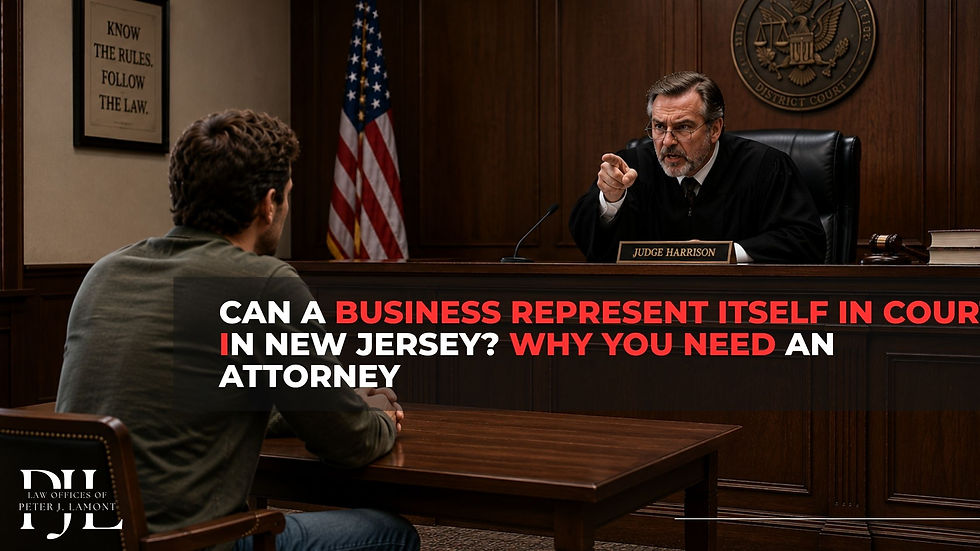
If your small business is sued in New Jersey or needs to bring its own claim, one of the first questions you face is whether you can handle the case yourself. The short answer surprises most business owners. In New Jersey, a corporation, LLC, or other business entity generally cannot represent itself in court. Only a licensed attorney can speak for the company. Trying to walk into a courtroom and argue on behalf of your business can result in your case being dismissed before you ever get a chance to be heard.
The General Rule in New Jersey
New Jersey court rules treat business entities as legal persons separate from their owners. Because a corporation or LLC is not a natural person, it cannot speak, sign pleadings, or appear in court on its own. It must act through an attorney admitted to practice in New Jersey. Rule 1:21-1 of the Rules Governing the Courts of the State of New Jersey makes this clear, and judges enforce it strictly. Even if you are the sole shareholder of a corporation or the only member of an LLC, you are not legally the same as your business. You may own the company, but the company is its own legal entity, and that entity needs a lawyer.
Why the Rule Exists
This rule is not designed to make life difficult for small business owners. It exists to protect the integrity of the court system, the parties on the other side of a case, and even the business itself. Lawyers are trained, licensed, and bound by ethical rules. They owe duties to the court and to opposing counsel. Allowing untrained owners to argue legal cases on behalf of corporations could lead to procedural chaos, missed deadlines, mishandled evidence, and unfair advantages or disadvantages. Requiring counsel keeps the playing field level and the process orderly.
The Limited Exceptions
There are a few narrow situations where a non-attorney can appear on behalf of a business in New Jersey. The most common is in the Small Claims Section of the Special Civil Part, where claims are limited to $5,000 or less. In that limited setting, Rule 6:11 permits any authorized officer or employee of a business entity to prosecute or defend claims on behalf of the entity, provided those claims originate with the entity and were not acquired by transfer or assignment.
Another narrow exception appears in landlord-tenant summary actions under Rule 6:10. The general prohibition still applies to corporations and LLCs in those cases. The only carve-out is for a partner in a general partnership, who may file papers and appear pro se on behalf of the partnership. There are also limited administrative proceedings where representation rules are more relaxed. These exceptions are narrow, fact-specific, and easy to misapply. If you are not absolutely certain that your situation qualifies, you should assume it does not and retain counsel.

What Happens If You Try to Represent Your Business Anyway
The consequences of attempting to represent your business in a case where counsel is required can be severe. A judge can strike your pleadings, enter default against your company, or dismiss your claims entirely. If your business was the plaintiff, you may lose the right to pursue your case. If your business was the defendant, a default judgment can be entered against you, exposing the company to liability and potential collection actions. Some business owners only learn about the rule after a default has been entered, at which point fixing the problem is much harder and much more expensive than it would have been to hire counsel from the start. A New Jersey business attorney can prevent these mistakes before they happen.
Why You Would Not Want to Represent Your Business Even If You Could
Even in the narrow situations where a business owner is permitted to appear without counsel, doing so is rarely a good idea. Litigation is not just about telling your side of the story. It involves understanding the rules of evidence, drafting pleadings that comply with court rules, conducting and responding to discovery, filing and opposing motions, preserving objections, and presenting witnesses and exhibits in a legally sufficient way. Missing any one of these steps can be fatal to your case.
Business owners also tend to be too close to their own disputes. Emotions run high, especially when money, reputation, or years of work are on the line. An attorney brings objectivity, strategic distance, and an honest assessment of strengths and weaknesses. Judges and opposing counsel also treat represented parties differently. Cases handled by experienced attorneys move more efficiently, settle on better terms, and avoid the kinds of procedural errors that derail self represented litigants.
The Hidden Costs of Going It Alone
Many business owners try to save money by handling a case themselves, only to spend far more later trying to fix the damage. A poorly drafted answer can waive defenses. A missed deadline can forfeit a counterclaim. An incomplete discovery response can result in sanctions. By the time an attorney is brought in to clean up the mess, the case may be in a much worse position than it was at the beginning. The money saved on legal fees in the short term is almost always dwarfed by what it costs to repair preventable mistakes.
The Bottom Line
If your business is involved in a lawsuit in New Jersey, do not try to handle it yourself. The rule against self-representation for corporations and LLCs is real, it is enforced, and it exists for good reasons. Even when an exception technically applies, the risks of going it alone almost always outweigh the cost of hiring counsel. Investing in an experienced New Jersey business attorney at the start of a case is one of the most effective ways to protect your company, your finances, and your peace of mind. The smartest move a business owner can make is to recognize when a problem requires professional help and to bring in counsel before small problems become permanent ones.
Contact us today to discuss your business or legal matter. Put our 20+ years of legal experience to work for you.
For detailed insights and legal assistance on topics discussed in this post, including litigation, contact the Law Offices of Peter J. Lamont at our Bergen County Office. We're here to answer your questions and provide legal advice. Contact us at (201) 904-2211 or email us at info@pjlesq.com.
Interested in More Legal Insights?
Explore our range of resources on business and legal matters. Subscribe to our podcast and YouTube channel for a wealth of information covering various business and legal topics. For specific inquiries or to discuss your legal matter with an attorney from our team, please email me directly at pl@pjlesq.com or call at (201) 904-2211. Your questions are important to us, and we look forward to providing the answers you need.

About Peter J. Lamont, Esq.
Peter J. Lamont is a nationally recognized attorney with significant experience in business, contract, litigation, and real estate law. With over two decades of legal practice, he has represented a wide array of businesses, including large international corporations. Peter is known for his practical legal and business advice, prioritizing efficient and cost-effective solutions for his clients.
Peter has an Avvo 10.0 Rating and has been acknowledged as one of America's Most Honored Lawyers since 2011. 201 Magazine and Lawyers of Distinction have also recognized him for being one of the top business and litigation attorneys in New Jersey. His commitment to his clients and the legal community is further evidenced by his active role as a speaker, lecturer, and published author in various legal and business publications.
As the founder of the Law Offices of Peter J. Lamont, Peter brings his Wall Street experience and client-focused approach to New Jersey, offering personalized legal services that align with each client's unique needs and goals.
DISCLAIMERS: The contents of this website and post are intended to convey general information only and not to provide legal advice or opinions. The contents of this website and the posting and viewing of the information on this website should not be construed as, and should not be relied upon for, legal or tax advice in any particular circumstance or fact situation. Nothing on this website is an offer to represent you, and nothing on this website is intended to create an attorney‑client relationship. An attorney-client relationship may only be established through direct attorney‑to‑client communication that is confirmed by the execution of an engagement agreement.
As with any legal issue, it is important that you obtain competent legal counsel before making any decisions about how to litigate a matter on behalf of a business entity, even if you believe self-representation may be permitted. Because each situation is different, it may be impossible for this article to address all issues raised by every matter involving business entity representation in court. The information above can give you guidance regarding some common issues, but you should consult with an attorney before taking any actions (or refraining from acts) based on this discussion. This post focuses on New Jersey law. If your business matter arises in a state other than New Jersey, you should immediately seek the advice of an attorney in your state, as certain rules differ in other states.
Disclaimer: Recognition by Legal Awards
The legal awards and recognitions mentioned above do not constitute an endorsement or guarantee of future performance. These honors reflect an attorney's past achievements and should not be considered as predictors of future results. They are not intended to compare one lawyer's services with those of other lawyers. The process for selecting an attorney for these awards can vary and may not include a review of the lawyer's competence in specific areas of practice. Potential clients should perform their own evaluation when seeking legal representation. No aspect of this advertisement has been approved by the Supreme Court of New Jersey.


Comments