

Seasonal Phishing And Data Breach Response Over Office Closures In New Jersey

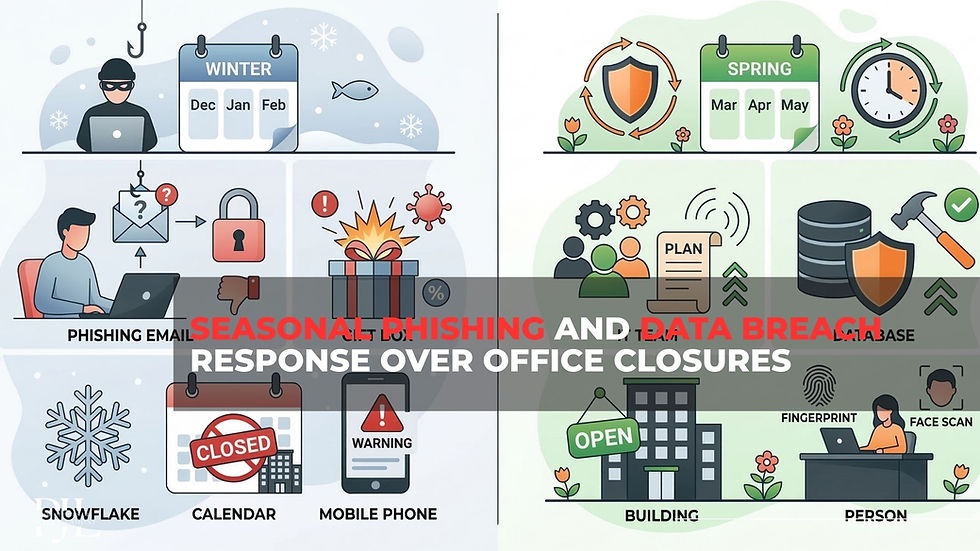
Seasonal Phishing And Data Breach Response Over Office Closures
December creates the exact conditions attackers prefer. Staff is thin, systems are running on scheduled jobs, vendors are operating with skeleton crews, and executives are traveling. Phishing campaigns, credential stuffing, and payment diversion attempts spike in the final weeks of the year. New Jersey law does not pause because offices close. The legal duty to protect personal information and to notify affected residents after a breach remains the same, and regulators evaluate what your company actually did once it learned of the issue, not what it meant to do after the holidays.
Why Holiday Phishing Works And What That Means Legally
Most year-end incidents begin with a convincing email, text, or login prompt that captures credentials and pivots into mailboxes, cloud drives, or finance systems. Once an inbox is compromised, rules can be created that hide incoming alerts and forward sensitive messages. Attackers then send payment instructions from the real account or harvest files that contain personal information. Under New Jersey’s data breach notification law, personal information means a resident’s name combined with a Social Security number, a driver’s license or state identification number, or a financial account number with any required code that permits access. Exposure of that data through unauthorized access triggers statutory duties.
The New Jersey Notification Framework
New Jersey requires disclosure to affected residents in the most expedient time possible and without unreasonable delay, consistent with measures needed to determine the scope of the breach and to restore system integrity, and consistent with any request from law enforcement that notice would impede an investigation. Before notifying residents, a business that maintains computerized records for New Jersey residents must give notice to the New Jersey State Police so law enforcement is aware of the incident. If more than one thousand residents must be notified, you must also notify the nationwide consumer reporting agencies. These requirements apply whether your business discovered the breach on a weekday morning or on the evening of December 23rd.
Immediate Steps When An Incident Surfaces During A Closure
A proper data breach response New Jersey businesses must follow starts with speed. The effective response begins with containment and documentation. Disable or reset compromised credentials, revoke active sessions, and remove malicious forwarding rules. Isolate affected devices or cloud tenants. Confirm that multifactor authentication is active and working. Lock finance processes by requiring verbal verification with a known contact before any payment or banking change is accepted. Create a dated log that records who discovered the issue, when containment steps were taken, what systems were involved, and which vendors were contacted. This log forms the backbone of your legal response and shows that the company acted promptly.
Forensics, Scoping, And The Decision To Notify
New Jersey law allows time to determine the scope of an incident and whether personal information was accessed. The analysis is evidence-driven. If a mailbox was compromised, counsel and a qualified forensic team should examine access logs, export rules, and message content to determine whether messages containing personal information were opened or exfiltrated. If a file share was reached, determine which folders were accessed and for how long. Where the facts support that personal information was accessed by an unauthorized party, notification obligations attach. Where the facts support that personal information was not accessed or acquired, the company may document its findings and close the matter while retaining the record of the investigation.
Coordinating With Vendors And Insurers
Many incidents involve managed service providers, cloud platforms, payment processors, and benefits administrators. Contracts often require immediate notice and cooperation. Provide written notice to involved vendors and request logs, timelines, and contact information for their security leads. Tender the incident to your cyber insurer or to your general liability carrier if you do not carry a dedicated cyber policy. Most cyber policies provide access to a breach coach, forensics, notification vendors, and credit monitoring services. Early notice secures coverage and prevents disputes over late reporting.
Content And Method Of Resident Notice
Notices to residents must be clear and factual. They should state the incident window, the types of personal information involved, the steps taken to contain and remediate, and measures residents can take to protect themselves, such as fraud alerts and security freezes. If a Social Security number or a financial account number with a required access code was involved, offering credit monitoring or identity theft services is common and prudent. Delivery may be by written notice, electronic notice consistent with the federal E Sign Act, or substitute notice if cost or scope meets the statutory threshold. Preserve copies of every version that is sent.
Law Enforcement Coordination And Timing
When the New Jersey State Police request delayed notice to residents because public disclosure would impede an investigation, document that request and the dates it covers. Once the hold is lifted, proceed with resident notification without delay and record the steps taken. Courts and regulators judge reasonableness by the quality of the timeline and the paper trail.
Employment and Vendor Discipline During Holiday Weeks
Incidents that begin with employee mistakes or vendor failures must still be addressed during holiday staffing. Issue targeted reminders that payment changes require phone verification with known numbers. Suspend the creation of new vendor records during closures unless approved by finance leadership. Require a second reviewer for any off-cycle payments. Reinforce that employees must report suspected phishing immediately and must not attempt to investigate on their own devices. These measures are simple to implement and are persuasive when regulators assess whether the company acted responsibly during a high-risk period.
Preservation, Privilege, And Communications
Litigation often follows data incidents, making thorough data breach response New Jersey compliance critical from day one. Preserve relevant logs, emails, tickets, chat threads, security alerts, and vendor communications. Issue a litigation hold once counsel is engaged. Route investigative work through counsel to support privilege over legal advice and strategy, while recognizing that underlying facts and final notification content are not privileged. Use careful internal messaging that is factual and avoids speculation. External statements should be coordinated so that public communications match resident notices and regulatory filings.
Ransomware And Encrypted Data During Closures
If systems are encrypted during a closure, the response must account for legal, technical, and business factors. Confirm backups are viable and separate from the impacted environment, then weigh restoration against other options with counsel and your insurer. Document the decision process. If personal information was accessed before encryption, notification duties may still apply. If encryption occurred without evidence of access or exfiltration, scoping work should focus on whether the attacker obtained the data or simply locked your systems.
What Enforcement And Litigation Look Like
Post-incident scrutiny of your data breach response New Jersey regulators conduct focuses on speed and quality. Regulators and plaintiffs’ counsel request the timeline, the forensic findings, copies of notices, contracts with vendors who touched the data, and proof of security controls such as multifactor authentication and logging. They test whether the company notified the State Police before contacting residents and whether credit reporting agencies were notified when the thousand-resident threshold was crossed. Companies that act promptly, keep a clean record, and communicate accurately are positioned to defend their decisions. Companies that delay for convenience or fail to preserve evidence face avoidable exposure.
Conclusion
Plan now for holiday risk. Require multifactor authentication, train on year-end phishing patterns, lock down payment change procedures, and confirm that backups are working. If an incident occurs, contain it, document every step, coordinate with counsel and forensics, notify the State Police when required, and provide clear notices to residents without unreasonable delay. This disciplined approach satisfies New Jersey’s legal standards and protects the business when the calendar and the threat actors are working against you.
For more information about your legal rights or to schedule a consultation, please contact the Law Offices of Peter J. Lamont at www.pjlesq.com, call 201-904-2211, or email info@pjlesq.com.
Contact us today to discuss your business or legal matter. Put our 20+ years of legal experience to work for you.
For detailed insights and legal assistance on topics discussed in this post, including litigation, contact the Law Offices of Peter J. Lamont at our Bergen County Office. We're here to answer your questions and provide legal advice. Contact us at (201) 904-2211 or email us at info@pjlesq.com.
Interested in More Legal Insights?
Explore our range of resources on business and legal matters. Subscribe to our podcast and YouTube channel for a wealth of information covering various business and legal topics. For specific inquiries or to discuss your legal matter with an attorney from our team, please email me directly at pl@pjlesq.com or call at (201) 904-2211. Your questions are important to us, and we look forward to providing the answers you need.

About Peter J. Lamont, Esq.
Peter J. Lamont is a nationally recognized attorney with significant experience in business, contract, litigation, and real estate law. With over two decades of legal practice, he has represented a wide array of businesses, including large international corporations. Peter is known for his practical legal and business advice, prioritizing efficient and cost-effective solutions for his clients.
Peter has an Avvo 10.0 Rating and has been acknowledged as one of America's Most Honored Lawyers since 2011. 201 Magazine and Lawyers of Distinction have also recognized him for being one of the top business and litigation attorneys in New Jersey. His commitment to his clients and the legal community is further evidenced by his active role as a speaker, lecturer, and published author in various legal and business publications.
As the founder of the Law Offices of Peter J. Lamont, Peter brings his Wall Street experience and client-focused approach to New Jersey, offering personalized legal services that align with each client's unique needs and goals.
DISCLAIMERS: The contents of this website and post are intended to convey general information only and not to provide legal advice or opinions. The contents of this website and the posting and viewing of the information on this website should not be construed as, and should not be relied upon for, legal or tax advice in any particular circumstance or fact situation. Nothing on this website is an offer to represent you, and nothing on this website is intended to create an attorney‑client relationship. An attorney-client relationship may only be established through direct attorney‑to‑client communication that is confirmed by the execution of an engagement agreement.
As with any legal issue, it is important that you obtain competent legal counsel before making any decisions about how to respond to a subpoena or whether to challenge one, even if you believe that compliance is not required. Because each situation is different, it may be impossible for this article to address all issues raised by every situation encountered in responding to a subpoena. The information below can give you guidance regarding some common issues related to subpoenas, but you should consult with an attorney before taking any actions (or refraining from acts) based on these suggestions. This post will also focus on New Jersey law. If you receive a subpoena in a state other than New Jersey, you should immediately seek the advice of an attorney in your state, as certain rules differ in other states.
Disclaimer: Recognition by Legal Awards
The legal awards and recognitions mentioned above do not constitute an endorsement or guarantee of future performance. These honors reflect an attorney's past achievements and should not be considered as predictors of future results. They are not intended to compare one lawyer's services with those of other lawyers. The process for selecting an attorney for these awards can vary and may not include a review of the lawyer's competence in specific areas of practice. Potential clients should perform their own evaluation when seeking legal representation. No aspect of this advertisement has been approved by the Supreme Court of New Jersey.


Comments